PREAMBLE DECLARATION OF INDEPENDENCE JULY 4, 1776
https://www.archives.gov/founding-docs/declaration
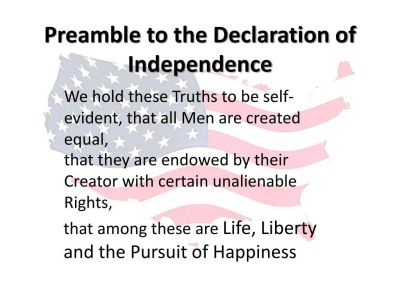
Preamble to the Declaration of Independence
“We hold these truths to be self-evident, that all men are created equal, that they are endowed by their Creator with certain unalienable Rights, that among these are Life, Liberty and the pursuit of Happiness.”
CONSTITUTION OF THE UNITED STATES RATIFIED JUNE 21, 1788
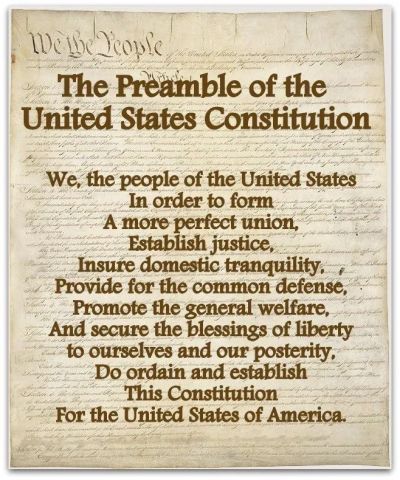
PREAMBLE CONSTITUTION OF THE UNITED STATES
"We the People of the United States, in Order to form a more perfect Union, establish Justice, insure domestic Tranquility, provide for the common defence, promote the general Welfare, and secure the Blessings of Liberty to ourselves and our Posterity, do ordain and establish this Constitution for the United States of America.
"The Constitution of the United States: A Transcription | National Archives
CONSTITUTION OF THE UNITED STATES RATIFIED JUNE 21, 1788
ARTICLES OF THE CONSTITUTION (7)
The Constitution of the United States: A Transcription | National Archives
The seven articles make up the structure of the federal government:
Articles I–III establish the legislative, executive, and judicial branches.
Articles IV–VII address state relations, amendments, national supremacy, and ratification signed on September 17, 1787
Example:
• Article I: Establishes Congress and its legislative powers. • Article II: Establishes the Presidency and executive powers.• Article III: Establishes the Supreme Court and federal judiciary.• Article IV: Defines state–federal relations.• Article V: Provides the amendment process.• Article VI: Establishes federal supremacy.• Article VII: Details ratification.
https://www.archives.gov/founding-docs/constitution-transcript

TEN (10) AMENDMENTS WERE RATIFIED DECEMBER 15, 1791
THE BILL OF RIGHTS IS Amendments 1-10 ( I-X) added to the Constitution that “lacked limits on government power”
Bill of Rights: First 10 Amendments | What is the Bill of Rights?
Amendments 11-27 were ratified between 1795-1992

THE FIFTH AMENDMENT (V) RATIFIED DECEMBER 15, 1791
"No person shall be held to answer for a capital, or otherwise infamous crime, unless on a presentment or indictment of a Grand Jury, except in cases arising in the land or naval forces, or in the Militia, when in actual service in time of War or public danger.• No person shall be subject for the same offence to be twice put in jeopardy of life or limb.• No person shall be compelled in any criminal case to be a witness against himself.• No person shall be deprived of life, liberty, or property, without due process of law.• No private property shall be taken for public use, without just compensation. "
THE FOURTEENTH AMENDMENT (XIV) RATIFIED JULY 9, 1868
THREE CORE CLAUSES
- Grants birthright citizenship: anyone born or naturalized in the U.S. is a citizen of both the nation and their state
- Prohibits states from depriving any person of life, liberty, or property without due process of law.
- Requires states to provide equal protection of the laws to all persons
14th amendment VIDEO: https://www.youtube.com/watch?v=TXHvIq17HrE
18 U.S.C. § 3332 POWERS AND DUTIES OF GRAND JURY
....establishes the powers and duties of special grand juries, which are convened to investigate criminal activity, organized crime, or misconduct by public officials. These juries operate in addition to regular grand juries...
Statutory Text:
(a) It shall be the duty of each grand jury impaneled within any judicial district to inquire into offenses against the criminal laws of the United States alleged to have been committed within that district. Such alleged offenses may be brought to the attention of the grand jury by the court or by any attorney appearing on behalf of the United States for the presentation of evidence. Any such attorney receiving information concerning such an alleged offense from any other person shall, if requested by such other person, inform the grand jury of such alleged offense, the identity of such other person, and such attorney’s action or recommendation.
18 U.S. CODE § 241 CIVIL RIGHTS DIVISION
CONSPIRACY AGAINST RIGHTS
Conspiracy against rights
If two or more persons conspire to injure, oppress, threaten, or intimidate any person in any State, Territory, Commonwealth, Possession, or District in the free exercise or enjoyment of any right or privilege secured to him by the Constitution or laws of the United States, or because of his having so exercised the same; or
If two or more persons go in disguise on the highway, or on the premises of another, with intent to prevent or hinder his free exercise or enjoyment of any right or privilege so secured—
They shall be fined under this title or imprisoned not more than ten years, or both; and if death results from the acts committed in violation of this section or if such acts include kidnapping or an attempt to kidnap, aggravated sexual abuse or an attempt to commit aggravated sexual abuse, or an attempt to kill, they shall be fined under this title or imprisoned for any term of years or for life, or both, or may be sentenced to death.
18 U.S. CODE § 242 CIVIL RIGHTS DIVISION
DEPRIVATION OF RIGHTS UNDER COLOR OF LAW
"Whoever, under color of any law, statute, ordinance, regulation, or custom, willfully subjects any person in any State, Territory, Commonwealth, Possession, or District to the deprivation of any rights, privileges, or immunities secured or protected by the Constitution or laws of the United States, or to different punishments, pains, or penalties, on account of such person being an alien, or by reason of his color, or race, than are prescribed for the punishment of citizens, shall be fined under this title or imprisoned not more than one year, or both; and if bodily injury results from the acts committed in violation of this section or if such acts include the use, attempted use, or threatened use of a dangerous weapon, explosives, or fire, shall be fined under this title or imprisoned not more than ten years, or both; and if death results from the acts committed in violation of this section or if such acts include kidnapping or an attempt to kidnap, aggravated sexual abuse, or an attempt to commit aggravated sexual abuse, or an attempt to kill, shall be fined under this title, or imprisoned for any term of years or for life, or both, or may be sentenced to death."
18 U.S.C. § 241 criminalizes conspiracies to interfere with federally protected rights, while 18 U.S.C. § 242 criminalizes willful deprivation of rights under color of law, including by police or other officials. Both statutes carry penalties up to life imprisonment or death when aggravated factors such as kidnapping or death are involved.
ANTONIN SCALIA'S 1992 SUPREME COURT OPINION
Justice Antonin Scalia authored United States v. Williams, 504 U.S. 36 (1992).
United States v. Williams, 504 U.S. 36 (1992) LII / Legal Information Institute+1
Scalia, joined by Rehnquist, White, Kennedy, and Souter, held that the grand jury’s role is to decide whether there is enough evidence to proceed, not to determine guilt. Exculpatory evidence can be presented at trial. The decision limited the scope of prosecutorial duties before a grand jury and reinforced the accusatory function of the grand jury.
OF SIGNIFICANCE.....4TH ARM QUOTE!! ADD
The Supreme Court ruled that a district court may not dismiss an otherwise valid indictment
The Supreme Court ruled that a district court may not dismiss an otherwise valid indictment simply because the prosecutor failed to present exculpatory evidence to the grand jury.
Case Background
John H. Williams, Jr., a Tulsa, Oklahoma investor, was indicted by a federal grand jury on seven counts of making false statements to federally insured banks under 18 U.S.C. § 1014. The indictment alleged that Williams misrepresented his assets and interest income through two financial statements, including a "Market Value Balance Sheet" and a "Statement of Projected Income and Expense," which overstated his financial position and implied income from independent sources, when in fact some payments were funded by his own loans to the companies involved Cornell University.
Legal Issue
The central question was whether a district court could dismiss an indictment because the government did not present "substantial exculpatory evidence" to the grand jury, even if the indictment was otherwise valid Justia+1.
Supreme Court Holding
The Court, in an opinion by Justice Scalia, reversed the lower courts, holding that federal courts do not have supervisory authority to require prosecutors to present exculpatory evidence to the grand jury. The Court emphasized that the grand jury’s role is accusatory, not adjudicative, and its function is to determine whether there is sufficient evidence to indict, not to weigh evidence for guilt or innocence. Exculpatory evidence can be presented at trial, but the prosecutor is not obligated to present it to the grand jury Wikipedia+1.
Reasoning
The Court reasoned that imposing a duty on prosecutors to present exculpatory evidence would interfere with the grand jury’s independence and could undermine its accusatory function. The decision clarified that defendants bear the burden of challenging indictments and that withholding exculpatory evidence at the grand jury stage does not constitute grounds for dismissal unless it rises to prosecutorial misconduct CaseBriefs+1
Significance
United States v. Williams is a landmark case defining the limits of judicial oversight over grand jury proceedings. It protects prosecutors from being compelled to present exculpatory evidence to the grand jury and reinforces the principle that the grand jury’s role is to decide whether probable cause exists to indict, leaving the evaluation of guilt or innocence to the trial process Wikipedia+1. This case remains a key precedent in criminal procedure regarding grand jury indictments and prosecutorial discretion
In United States v. Williams, 504 U.S. 36 (1992), Justice Scalia reaffirmed that the Grand Jury is not an arm of the prosecution or judiciary, but an independent body serving as a protector and shield of the People against tyranny. Blocking the People’s evidence from reaching the Grand Jury strips away this safeguard, leaving citizens defenseless against government abuse.